Small Drones, Big Consequences: A Personal Reflection on the New Logic of War
There is something deeply unsettling about the shift we are witnessing in modern warfare. For decades, military power was synonymous with sophistication: advanced fighter jets, billion-dollar destroyers, precision-guided missiles. Power meant complexity, scale, and above all—cost. But today, that logic is being quietly, yet profoundly, overturned.
What strikes me most in the evolving conflicts—from Ukraine to the Strait of Hormuz—is not just the presence of new technology, but the inversion of value. Cheap has become powerful. Simple has become strategic.
Both Ukraine and Iran, facing militarily superior adversaries, are playing a different game. They are not trying to outgun their opponents in a conventional sense. Instead, they are trying to make war unbearably expensive for them. Ukraine does this by inflicting continuous damage on Russian forces. Iran, in its own context, threatens global chokepoints and targets regional allies of the United States. The objective is the same: raise the cost of continuing the fight.
And drones—small, relatively inexpensive, and increasingly autonomous—are at the center of this shift.
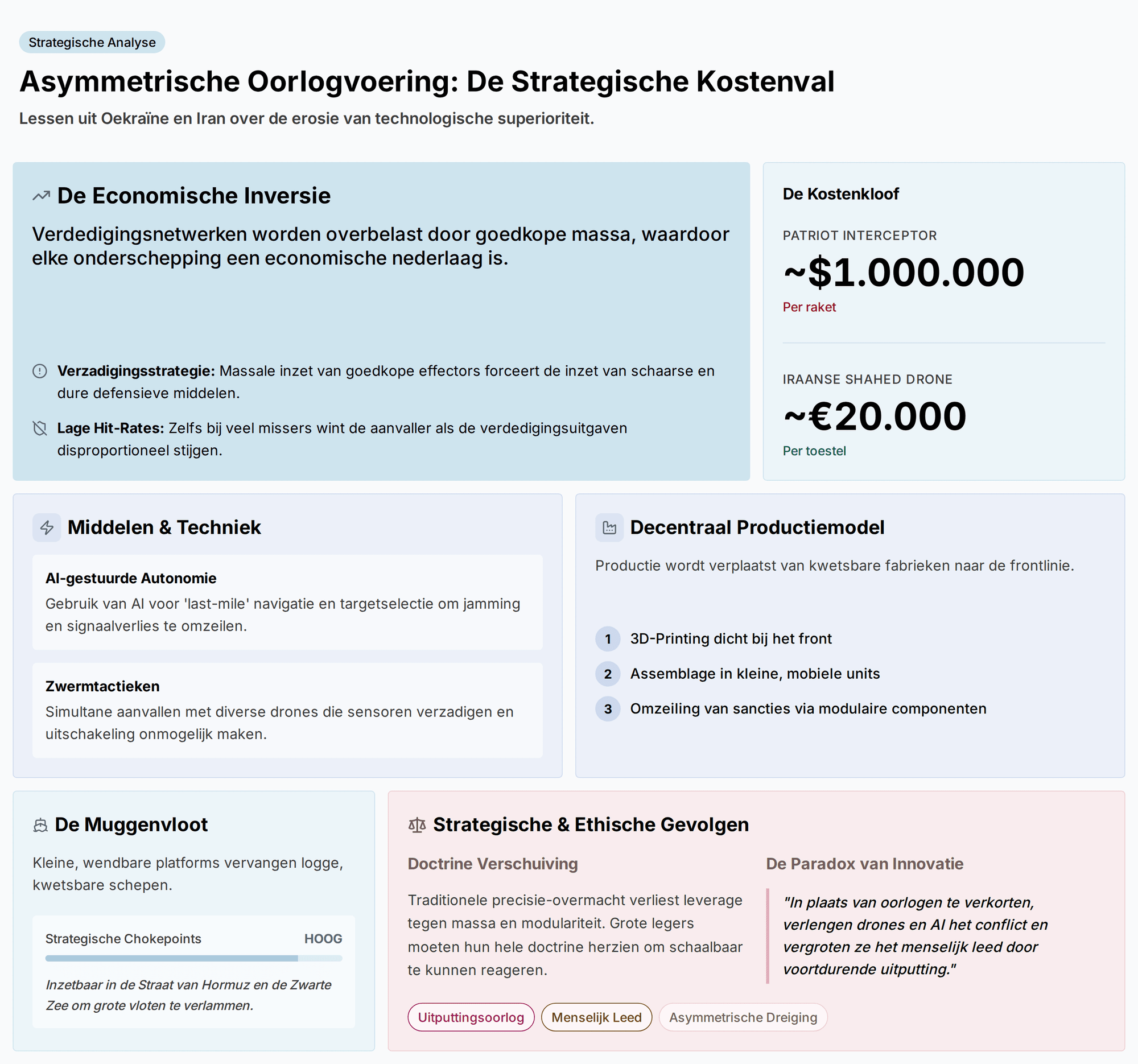
One of the clearest lessons drawn from the war in Ukraine is that weapons do not need to be complex or expensive to be effective. Iranian drones, for instance, can cost only tens of thousands of euros, yet they are capable of causing significant disruption and damage. More importantly, they are deployed in large numbers. Swarm tactics—sending waves of drones to overwhelm air defenses—have changed the calculus entirely. No defense system can intercept everything at once.
What makes this even more striking is the economic asymmetry. A low-cost drone can force the use of a high-end interceptor missile costing hundreds of thousands—or even over a million—dollars. From a purely financial perspective, this is not sustainable. It is warfare designed not just to destroy, but to exhaust.
And then there is the role of artificial intelligence. Increasingly, these drones are being designed to operate with limited or no human control, especially in environments where communication is disrupted. The idea that machines could autonomously select and engage targets is no longer theoretical—it is emerging reality. That raises profound ethical questions, but also signals a future where speed and scale will outpace human decision-making.
Equally important is how these systems are produced. Ukraine has demonstrated the power of decentralization—assembling drones close to the front line, often using 3D printing. This reduces logistical vulnerabilities and enables a constant flow of new systems. Iran, constrained by sanctions and limited access to global supply chains, is forced into similar creativity. The result is a model of distributed, resilient production that is much harder to disrupt.
This same philosophy extends beyond the air domain. At sea, Iran’s so-called “mosquito fleet” of small, agile boats mirrors the Ukrainian use of naval drones in the Black Sea. Large, traditional naval assets are no longer the only—or even the most relevant—measure of maritime power. Instead, mobility, numbers, and adaptability define effectiveness.
What we are seeing is the rise of true asymmetric warfare. Smaller actors are no longer trying to match their opponents symmetrically. They are exploiting weaknesses—economic, technological, and structural. And in many cases, they are succeeding.
But there is a darker side to this transformation.
For years, there was a belief—especially in the West—that more advanced weapons would make wars shorter and more precise, and therefore more “humane.” Yet the reality unfolding in Ukraine suggests the opposite. Technology is not shortening war; it is sustaining it. By lowering the cost of participation and increasing the resilience of both sides, it allows conflicts to drag on indefinitely.
More tools, more innovation—yet also more suffering.
That is perhaps the most uncomfortable conclusion. We are not just witnessing a change in military tactics. We are witnessing a shift in the very nature of war itself—from decisive, high-intensity engagements to prolonged, distributed, and economically driven conflicts.
Small drones, in that sense, are not just weapons. They are symbols of a new era—one where power is measured not only in capability, but in adaptability, scalability, and cost-efficiency.
And that changes everything.