Europe’s AI Dilemma: Urgent Demand, Strategic Dependence, and the Palantir Question
Summary
European law enforcement is under growing pressure to adopt advanced AI capabilities, as illustrated by the Antwerp federal police, who warn that criminal organizations are already ahead. However, the most mature solutions are often provided by non-European vendors such as Palantir, which are increasingly positioning themselves as geopolitical actors rather than neutral technology providers.
This creates a structural dilemma for Europe: the urgent need for capability is pushing governments toward dependencies that existing governance frameworks are not equipped to manage. The core challenge is no longer technological, but strategic—how to maintain control, legitimacy, and alignment in an AI-driven security landscape.
European governments are facing a growing contradiction.
European governments are entering a phase where their technological choices in security and law enforcement are no longer purely operational decisions. Increasingly, they are becoming strategic—and political.
This shift is being driven by a growing contradiction. Law enforcement agencies are under mounting pressure to adopt advanced artificial intelligence capabilities to keep pace with rapidly evolving threats. At the same time, the most mature and operationally proven solutions are often developed and controlled by non-European actors whose strategic posture, and increasingly their ideology, does not fully align with European governance principles.
Nowhere is this tension more visible than in Antwerp.
In a recent public intervention, the federal police in Antwerp made a strikingly candid assessment: criminal organizations are already leveraging artificial intelligence at scale, while law enforcement risks falling behind. These are not isolated or speculative developments. Criminal networks are using AI to automate fraud, optimize logistics, and scale operations in ways that were previously impossible. The response from law enforcement is equally clear. They need more advanced technological capabilities, and they need them urgently.
Yet the same officials acknowledge a fundamental constraint. The limitation is not what technology can do, but what institutions are allowed to do. European law enforcement operates within a framework defined by privacy protections, proportionality, data sovereignty, and legal accountability. These are not incidental features of the system; they are foundational. But in practice, they create a structural tension. While criminal actors operate without constraint, public authorities must continuously balance capability with legality and legitimacy.
The result is a widening gap between what is technically possible and what is institutionally deployable.
What law enforcement is now asking for goes far beyond incremental improvements. It is a demand for a different class of system altogether: platforms capable of integrating large volumes of data across domains, enabling real-time intelligence fusion, supporting predictive analysis, and assisting operational decision-making. These are not standalone tools but complex, deeply integrated infrastructures.
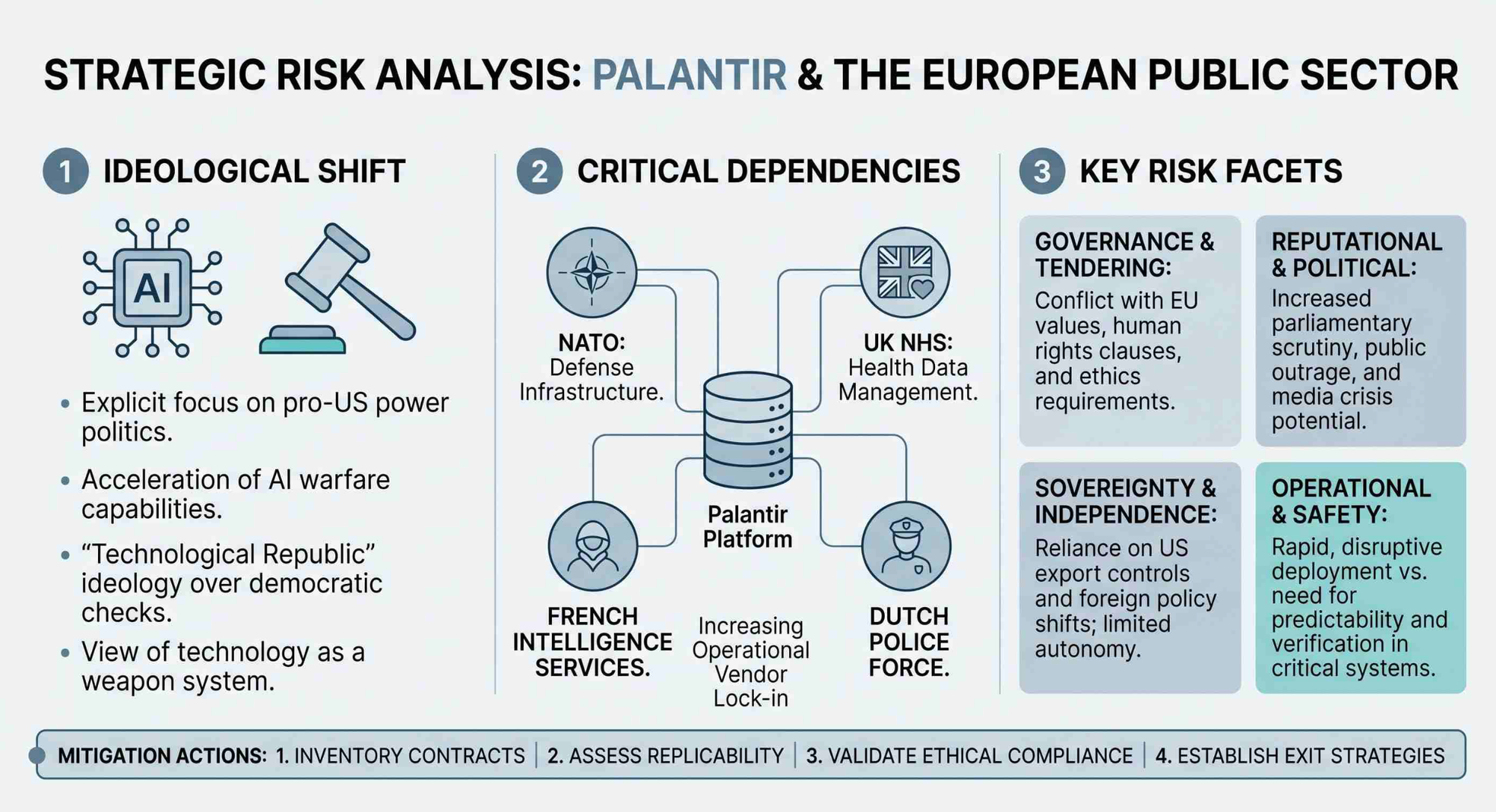
At present, only a limited number of companies are able to deliver such systems at scale. Among them, Palantir occupies a particularly prominent position. Its platforms are already embedded in critical environments, ranging from defense and intelligence contexts to national policing systems and healthcare infrastructure such as the UK’s National Health Service. This level of integration creates a structural reality that is difficult to ignore: the more central the capability becomes, the harder it is to replace the provider.
For years, such dependencies were treated primarily as technical or commercial risks. That assumption is no longer sufficient.
With the publication of a set of ideological theses linked to CEO Alexander Karp’s The Technological Republic, Palantir has moved beyond the role of a discreet technology supplier. The company now articulates a clear position on the role of technology in geopolitics, emphasizing the inevitability of AI-enabled military systems, the need for technological acceleration in defense, and the centrality of software as an instrument of strategic power.
This does not make Palantir unique. What makes it significant is the explicitness of this positioning. It transforms the company from a vendor into an actor with a defined worldview, and that shift fundamentally alters the nature of its relationship with public institutions.
The implications of this shift are particularly pronounced in Europe. The European governance model is built on principles of democratic oversight, legal proportionality, human rights protection, and institutional accountability. It is a system that deliberately incorporates friction as a safeguard. By contrast, the technological doctrine articulated by Palantir places a premium on speed, execution, and strategic advantage, with less emphasis on procedural constraints.
These are not simply different preferences; they reflect fundamentally different approaches to how technology should be governed and deployed. The contrast becomes even more apparent when viewed alongside companies such as Anthropic or OpenAI, which have publicly emphasized the risks associated with their technologies and called for safeguards and external oversight. Where those actors highlight caution, Palantir emphasizes acceleration.
This divergence is no longer confined to theoretical debate. In the United Kingdom, Palantir’s role in public sector systems has become the subject of increasing political scrutiny. Its involvement in the NHS has triggered parliamentary debate, public petitions, and broader concerns about transparency, accountability, and long-term dependency. The discussion is no longer about whether the technology is effective. It is about whether its use aligns with public expectations and democratic legitimacy.
Beneath these debates lies a deeper and more structural issue: dependency. When technological systems become embedded in operational workflows, data infrastructures, and decision-making processes, they are not easily replaced. This is particularly true in environments such as defense, healthcare, and law enforcement, where continuity and reliability are critical. Over time, this creates a form of lock-in that is as much institutional as it is technical. Governments may retain formal control, but their practical room for maneuver becomes increasingly constrained.
This dynamic brings Europe to a strategic crossroads. On one side is the undeniable need for advanced AI capabilities, driven by real-world pressures such as those observed in Antwerp. On the other is the reality that the most readily available solutions may come with governance assumptions and strategic alignments that do not fully correspond to European values and priorities.
In effect, Europe is being pushed toward dependence on systems it does not entirely control, while lacking the frameworks to manage the implications of that dependence.
Current regulatory and procurement models are not designed for this situation. They focus on data protection, cybersecurity, and competition, all of which remain essential. However, they do not adequately address the question of how to evaluate and manage the long-term strategic alignment of critical technology suppliers. In an era where technology companies can articulate explicit geopolitical positions, that gap becomes increasingly difficult to ignore.
The challenge, therefore, is not simply to acquire advanced capabilities, nor to reject them. It is to develop a governance approach that recognizes the strategic nature of these dependencies and addresses them accordingly.
The case of Antwerp illustrates the urgency of the demand. The debate around Palantir illustrates the complexity of the supply. Between the two lies a governance gap that Europe has yet to close.
Bridging that gap will determine not only how effectively European institutions can respond to emerging threats, but also whether they can do so while maintaining control over the systems on which they rely.